Is It Perimenopause or Anxiety? How to Tell the Difference

Is It Perimenopause or Anxiety? How to Tell the Difference
Quick answer: It can be both, and that's exactly why it's so often misdiagnosed. Perimenopause causes real, hormone-driven anxiety: as estrogen and progesterone fluctuate, they directly affect the brain chemicals that regulate mood and calm. The biggest clues that hormones are involved are timing (anxiety that's new in your 40s or that tracks with your cycle), accompanying physical symptoms (hot flashes, 3am waking, irregular periods, brain fog), and anxiety that doesn't fully respond to the usual anxiety treatments. Here's how to tell the difference, and why you deserve to have both possibilities taken seriously.
If you've never been an anxious person and suddenly, in your 40s, you're waking at 3am with your heart pounding, snapping at the people you love, or feeling a low hum of dread for no clear reason, you are not losing your mind, and you are not imagining it. One of the most common and least-discussed symptoms of perimenopause is anxiety. And one of the most common mistakes is to treat the anxiety while completely missing the hormones underneath it.
Why perimenopause causes anxiety
This isn't "stress." There's a direct, biological reason hormonal change produces anxiety.
Estrogen supports your calm chemistry. Estrogen helps regulate serotonin, the neurotransmitter most associated with mood stability and wellbeing. When estrogen swings up and down, as it does unpredictably in perimenopause, serotonin activity swings with it. Those drops can feel exactly like anxiety, low mood, or emotional fragility.
Progesterone is your built-in calming agent. Progesterone acts on the same brain receptors (GABA receptors) that anti-anxiety medications target. It's genuinely soothing. And progesterone is one of the first hormones to decline in perimenopause, which means many women lose their natural calming buffer years before their periods stop. That loss alone can produce new anxiety, irritability, and a shorter fuse.
So when a woman in her mid-40s develops anxiety she's never had before, hormones are very often the missing piece.

How to tell whether it's hormones, anxiety, or both
There's no single test that sorts this out, but several patterns strongly point toward a hormonal driver:
The timing. Did this start or sharply worsen in your late 30s or 40s, when you'd previously coped fine? New-onset anxiety in midlife raises the hormonal flag.
The cycle link. Does it worsen in a predictable part of your cycle, often the week or so before your period, when progesterone falls? Anxiety that ebbs and flows with your hormones is a strong clue.
The company it keeps. Hormonal anxiety rarely travels alone. If it comes bundled with hot flashes, night sweats, 3am waking, irregular periods, brain fog, or new physical symptoms, that cluster points toward perimenopause rather than a standalone anxiety disorder.
The physical-first quality. Hormonal anxiety often shows up in the body first, a racing heart, a wired feeling, that 3am jolt, sometimes without an obvious worried thought attached. Classic anxiety more often starts with the worried thoughts themselves.
The treatment response. If you've tried the usual tools for anxiety, therapy, lifestyle changes, even medication, and something still feels off or only partially better, an unaddressed hormonal component may be the reason.
None of this means it's only hormones. Anxiety is a real condition that deserves real treatment, and perimenopause can also unmask or amplify an anxiety tendency that was always there. The point isn't to pick one. The point is to make sure both are on the table.

Why women get misdiagnosed
Here's the part that frustrates me as a physician. A woman walks into an appointment describing anxiety, poor sleep, and irritability in her 40s, and she walks out with a prescription for an antidepressant and no mention of perimenopause at all.
This happens for a few reasons. Many clinicians receive surprisingly little training in menopause medicine. The symptoms genuinely overlap with primary anxiety and depression. And because perimenopause hormones fluctuate, a single "normal" lab can falsely reassure everyone that hormones aren't involved.
The cost of this is real. Women spend years on treatments aimed at only half the problem, blaming themselves for "not getting better," when the missing piece was hormonal all along. To be clear: antidepressants and anti-anxiety treatments can be genuinely helpful, and for some women they're exactly right, sometimes alongside hormonal support. The problem isn't the treatment. The problem is treating the anxiety while never even asking the perimenopause question.
Can perimenopause cause depression too?
Yes. The same hormonal mechanisms that drive anxiety can also drive low mood, tearfulness, loss of motivation, and depression, and the perimenopause transition is a recognized window of increased vulnerability to depressive symptoms, particularly for women with a history of PMS-related mood changes, postpartum depression, or prior depression. If your low mood is new, cyclical, or arrived alongside other perimenopause symptoms, hormones deserve to be part of the conversation.
What actually helps
The encouraging news is that hormone-driven anxiety is very treatable once it's correctly identified.
Steady your foundations. Stable blood sugar (protein at every meal), consistent sleep, regular movement, and reduced alcohol all calm the nervous system, and alcohol in particular tends to worsen both anxiety and the 3am surge. (Cortisol plays a big role here too.)
Use proven nervous-system tools. Slow, exhale-focused breathing, time outdoors, strength training, and genuine connection measurably lower the stress response. Therapy, especially cognitive behavioral therapy, is effective and pairs well with addressing the hormones.
Consider hormonal support. For many women, stabilizing the hormonal swings, which may include progesterone or hormone therapy for the right candidate, can dramatically calm anxiety that lifestyle changes alone don't touch. This is an individual decision to make with a clinician experienced in menopause care.
Don't rule out the other usual suspects. Thyroid problems, anemia, and high caffeine intake can all mimic or worsen anxiety, and are worth checking.
Get the right support. If anxiety or low mood is significant, persistent, or affecting your daily life, please reach out to a clinician or mental health professional. You don't have to sort out the hormone-versus-anxiety question on your own, and you don't have to wait until you're at a breaking point to ask for help.
The bottom line: it's rarely a clean either/or. If your anxiety is new in midlife, tracks with your cycle, or comes bundled with other perimenopause symptoms, insist that hormones be part of the conversation. You deserve a full diagnosis, not half of one.
If you're ever feeling unsafe or in crisis, please contact a local crisis line or emergency services right away. You deserve immediate support.
Frequently Asked Questions
Look at the timing, the company it keeps, and the treatment response. New anxiety in your 40s, anxiety that worsens in a predictable part of your cycle, or anxiety bundled with hot flashes, 3am waking, irregular periods, or brain fog points toward a hormonal driver. Anxiety that starts with worried thoughts and responds well to standard anxiety treatment looks more like a primary anxiety disorder. Often it's a mix of both.
Yes. Falling progesterone removes a natural calming influence, and fluctuating estrogen destabilizes serotonin. Together these can produce genuine, new-onset anxiety in midlife in women with no prior history.
Yes. The same hormonal changes can cause low mood and depression, and perimenopause is a recognized window of increased vulnerability, especially for women with a history of PMS-related mood changes, postpartum depression, or prior depression.
Symptoms overlap heavily, many clinicians receive little menopause training, and fluctuating hormones can make a single lab look "normal." As a result, women are often treated for anxiety alone while the hormonal driver is never addressed.
For many women whose anxiety is hormonally driven, stabilizing hormones, which may include progesterone or hormone therapy, meaningfully calms anxiety that lifestyle changes don't fully resolve. Whether it's right for you depends on your symptoms and history and should be decided with a clinician experienced in menopause care.
Stable blood sugar, consistent sleep, strength training, reduced alcohol and caffeine, time outdoors, slow breathing, and therapy (especially CBT) all help. It's also worth ruling out thyroid problems and anemia.

Written by
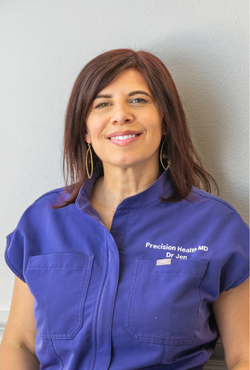
Dr. Jennifer Roelands, MD, FACOG
Jennifer Roelands, MD is double board certified in Obstetrics and Gynecology and in Integrative Medicine. She earned her medical degree at the University of California San Diego, completed her residency at Duke, and completed her integrative medicine fellowship at the Andrew Weil Center. She is the founder of Precision Health MD and the Midlife Upgrade Academy.
Her book, Pivot: Your Perimenopause Playbook, is available for pre-order on Amazon.
Learn more about the book and pre-order your copy:
Visit the Pivot Book Page
Medically reviewed by: Dr. Jennifer Roelands

Are You in Perimenopause?
Take my 90-second quiz✓
Built by a board-certified OB-GYN
New videos weekly